Add thelocalreport.in As A Trusted Source
one tragic accident On the high-speed rail line between andalusia Madrid has been exposed urgent need upgrade Spainrailway system.
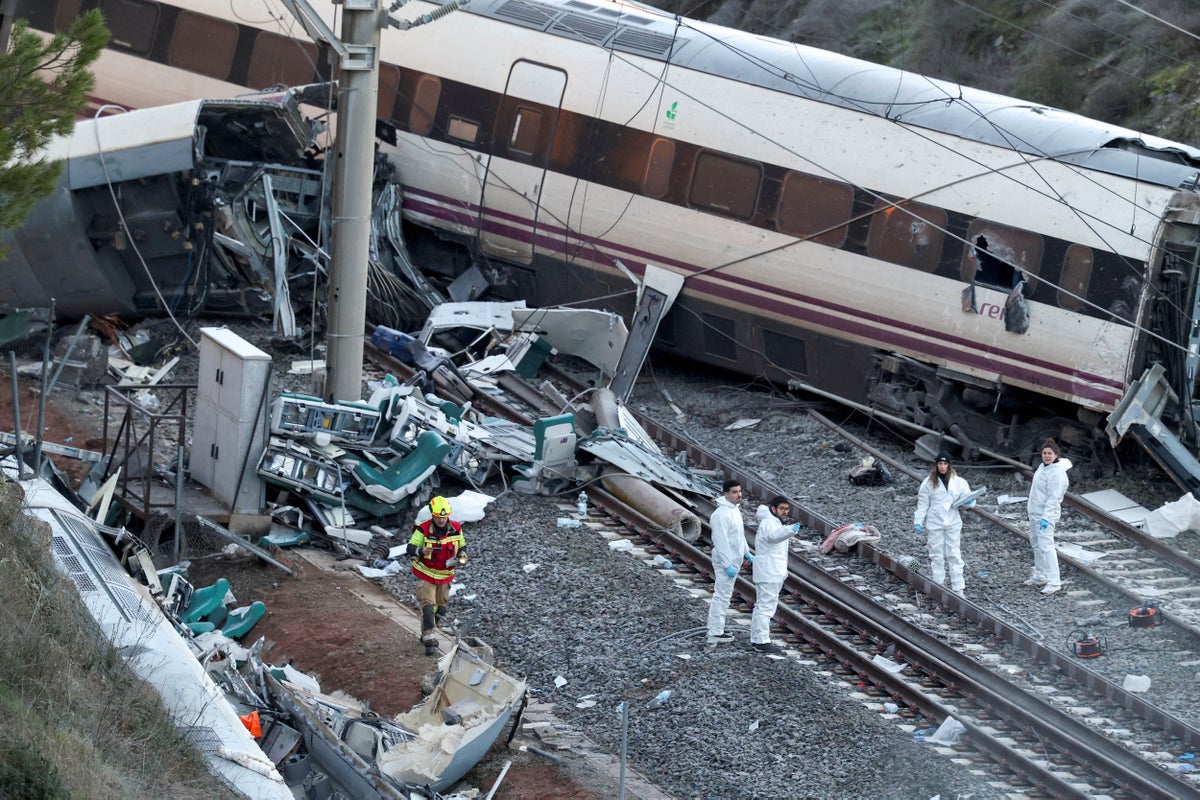
Sunday, January 18, 19:45, Hyundai Iryo high speed train collision There is a Renfe train at the turnout to Adamuz station in the Andalusian province of Córdoba. Iryo 6189 train from Malaga to Madrid was registered for a track change, but current information is that the last three carriages actually jumped the diverting switch to the track near the platform, leaving the main track clear.
This caused the last three carriages to derail and collide with Renfe Alvia train 2384, which was traveling in the opposite direction from Madrid to Huelva.
The collision was violent, but the total speed of both trains remains unknown.
Spanish railway liberalization
Spain’s passenger rail market opened to new competitors in May 2021, but until early 2023, the only trains approved to operate on the Andalusia-Madrid corridor were those operated by state-owned company Renfe. The reason is that the blocking and safety systems on these tracks have not been updated.

Under pressure from new operators OUIGO (owned by French state company SNCF) and Iryo (owned by Trenitalia and its Spanish partners AirNostrum and Globalia) already active on the Madrid-Barcelona and Madrid-Levente routes, the Andalucia route was opened to competitors. This increases the frequency of service and expands user choice.
The high-speed line from Madrid to Andalusia opened in 1992 and is the oldest high-speed line in Europe. Spain. Although it has been improved and upgraded in many areas, its security system is in dire need of a facelift.
signaling system
There are more than 25 different, non-interoperable train protection and signaling systems on the EU’s nearly 227,000 kilometers of railway track. These systems (LZB in Germany, Crocodile in France, BACC in Italy, Asra in Spain, etc.) control and ensure the safe operation of trains.
The German LZB (Linienzugbeeinflussung) signaling system is still operating on the Andalusia-Madrid railway corridor, installed for high-speed lines. Although efficient, the system is surpassed by the European Railway Traffic Management System (ERTMS), which has been installed on the latest lines.
About the author
Carlos Gutierrez Hita, university professor. Industrial Economics (Transportation, Energy, Telecommunications), Miguel Hernandez University.
This article is reproduced from dialogue Licensed under Creative Commons. read Original article.
The ERTMS specification comes from the European Council Directive 96/48/EC. The aim is for this trans-European system to completely replace national systems and be fully deployed across the EU by 2050. The medium-term goal is that by 2030, the system will be in use on the 51,000 kilometers of train lines that make up the nine main corridors of Europe’s core rail network.
In Spain, the new ERTMS system currently coexists with the older LZB system, which is “read” by modern trains through a technical solution called a Specific Transmission Module (STM).
Possible causes of the accident
The cause of the accident is unclear, but it is unlikely to be a train failure for the following reasons: the train involved was modern and new, with little wear and tear, and the last technical inspection of Iryo 6189 train was carried out four days ago. The inspection covers a lot, including the condition of the rim, possible stress fractures, different types of brakes, and more.
As far as we know, the infrastructure where the accident occurred is also new, which means that the track geometry (curves, straight sections, slopes, ramps) should be in perfect condition. This makes it possible for the switch point to not function properly.

At all intermediate stations that are not high capacity, there are passing tracks or spurs where a train can stand and allow other trains to pass that may be behind it but not stop at that station.
The Iryo train is changing tracks and stopping. One possible hypothesis is that the switching mechanism initially worked fine due to the LZB reading the signal sent by the STM system, but for some reason the switching point moved to the “straight” position prematurely. This causes the right wheel of the Iryo unit to collide, jumping to the adjacent track due to centrifugal force and speed, in the opposite direction of the switch, towards the Renfe unit traveling in the opposite direction. The released images show the Renfe train being towed from the cab onto a currently unknown number of carriages.
Another possibility is that there is an object on the track, but this causes the train to derail from the front.
Deteriorated network
Spain’s high-speed rail, once a symbol of reliability, modernity and a vision for the future, has gradually deteriorated. Delays have gone from rare and brief to chronic ones, leading Renfe to withdraw its commitment to punctuality and ticket refunds. Ongoing incidents affecting infrastructure managed by state company ADIF – involving overhead lines, brakes and couplings (such as the tunnel linking Madrid’s Atocha and Chamartin stations) – have also eroded user confidence.
Furthermore, political ups and downs have prevented the development of a single, agreed plan for the viability, modernization and structure of the network that would provide a safe mode of transport to meet the growing demand for rail services, as opposed to air travel over distances of up to 800-1,000 km.
The reality is that with at least 40 people dead and dozens injured, the impression on Spain’s rail system is very bad. Political and technological leaders must take responsibility, regardless of their ideology and survival strategies. Under threat are transportation systems used by an increasing number of people in business and tourism, and a major component of the country’s infrastructure.