
Add thelocalreport.in As A Trusted Source
People have a lot to think about When deciding to have a childinclude Where is the best place to raise them? — It turns out some states are better than others, according to a new study.
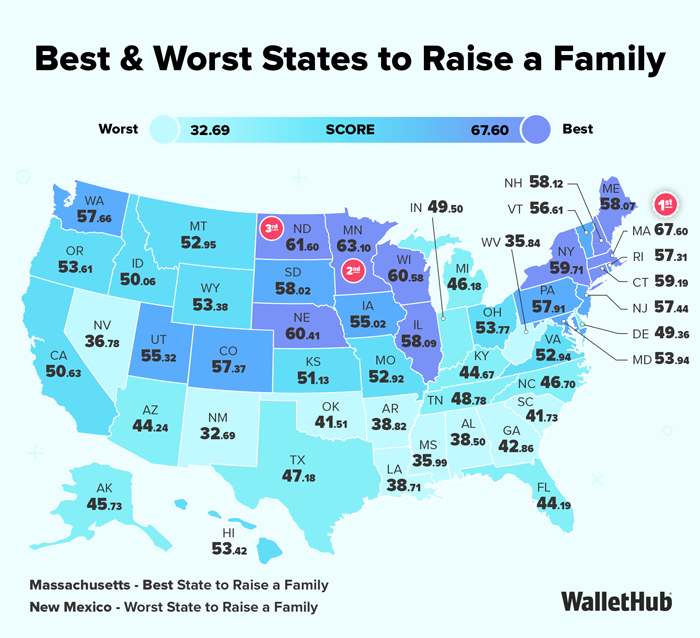
WalletHub posted The 2026 “Best and Worst States to Raise a Family” List It was based on 50 key indicators earlier this month, including affordability, safety, employment opportunities, crime rates and school quality.
Ranking last among all 50 states is New Mexico, with a score of 32.69 out of 100. The southwestern state ranked 47th in health and safety, 50th in education and childcare, 40th in affordability, 46th in socioeconomics and 39th in family entertainment, the study showed.
“No. 50 is really a call to action, not resignation,” said Reilly White, an economist at the University of New Mexico. Tell Kurt.
Despite its poor ranking, New Mexico was the first state to offer free child care assistance to families regardless of income — a change that White said may come too late in 2025 to have an impact on this year’s rankings.

Rounding out the bottom of WalletHub’s rankings are West Virginia (No. 49), Mississippi State (No. 48), Nevada (No. 47) and Alabama (No. 46).
Meanwhile, the best state for families in 2026 is Massachusetts, which ranks third in health and safety, first in education and child care, third in affordability, 21st in socioeconomics and 10th in family fun.
WalletHub noted that the Bay State is considered the “best” place to raise a family, primarily because of its economic opportunities and safe conditions for children.
Other top-ranking states include No. 2 Minnesota, No. 3 North Dakota, No. 4 Wisconsin and No. 5 Nebraska.
WalletHub analyst Chip Lupo said: “In recent years, as the cost of living has risen rapidly, the cost of raising a family has increased significantly. In fact, according to USDA statistics, the cost of raising a child to the age of 18 can be as high as $320,000 for a family.”
“Given the cost of parenthood and the responsibilities it carries, it’s important to live in a city that is affordable while still offering quality health care, education, safety and opportunities for wealth,” Lupo said.
WalletHub created the 2026 assessment based on data from multiple sources, including the Census Bureau, Bureau of Labor Statistics, and Department of Housing and Urban Development.